

RAISE JOURNAL
Publication Services
We offer publication services for the following:
- Journals
- Literary Works (poetry, memoirs, autobiographies, short stories, plays, novels, essays)
- Thesis / Dissertation
- E-books
- Conference Proceedings
Payment
Once an article is accepted, editing and formatting charges become due. The submitting author is responsible for these fees. No refunds will be issued for accepted submissions.
Publishing Policy
1.) Copyright Policy
Authors retain the copyright of their articles while granting the journal/publisher the right to first publication. After publication, authors may reuse, archive, republish, or distribute their work. The publisher bears no responsibility for the subsequent use of the content. All articles are assigned an ISSN and may be indexed accordingly.
2.) Open Access Policy
All journals are open access, allowing anyone to read, download, share, and use articles for lawful purposes. Publication costs are covered by authors, their institutions, or funding bodies. Proper citation/credit of authors and sources is required.
3.) Submission Policy
By submitting a manuscript/article, authors confirm it has not been previously published or submitted elsewhere (except as an abstract, thesis, or lecture). All authors and affiliated institutions must approve the submission. Submissions previously presented at conferences or shared via posters are accepted. Once published, authors must update preprints with the journal reference, DOI, and publication link.
We strictly enforce a zero-tolerance policy on plagiarism and self-plagiarism. All submissions are checked for originality.
4.) Copyright and License
Authors retain copyright on open access articles published by RAISE Journal.
Authors grant RAISE Journal the right to publish the article and be recognized as the original publisher.
Third parties may freely use the article, provided the content remains unchanged, and full credit is given to the authors, citation details, and publisher.
5.) Complaints Policy
This policy covers complaints about the publishing process, policies, or decisions of RAISE Journal editors and staff.
Complaints should be directed to the journal’s publishing team and must be related to processes under the journal’s jurisdiction.
General Paper Submission Format
- Title Page: Includes title, author(s), affiliation(s), ORCID number(s)
- Formatting:
- Font: Arial, size 12
- Line spacing: Double
- Margins: 1 inch (2.54 cm) on all sides
- Paragraph Indent: 0.5 inch (1.27 cm)
- Page Numbers: Bottom footer
- Tables/Figures: Maximum of 5 combined
- References: Use a consistent citation style (APA, MLA, Chicago, etc.)
Editing and Translation Process
Only the Managing Editor and assigned Language Editor—both bound by confidentiality—will access your manuscript.
Steps include:
- Subject-specific editing by a qualified editor
- Review by the Managing Editor
- Return of the edited manuscript within 3 to 6 months
We also offer translation services handled by subject experts with advanced language skills, especially for fields like medicine, life sciences, engineering, and business.
Our Editing Services Include:
- Correcting spelling, grammar, and punctuation
- Ensuring proper use of tenses, conjugations, and parallel structures
- Improving word choice and eliminating awkward phrasing
- Editing in American English
- Providing track-changes for transparency
Publication Ethics for Editors and Authors
Ethical conduct is crucial in research and publishing. We follow guidelines from professional organizations like AFTEACh Inc. and are committed to transparency and integrity in publishing.
Acknowledgments
We encourage transparency in disclosing contributors who assisted in writing or editing. Proper acknowledgment improves the credibility of the manuscript.
For queries, email: wengpila2000@gmail.com
Soft Copies for Online Publication
You will receive the Soft Copies of the Article and Certificates within 5-7 days.
- 50 – 1000 words: 26 USD | 1500 PHP
- 1001 – 2000 words: 35 USD | 2000 PHP
- 2001 – 3000 words: 45 USD | 2500 PHP
- 3001 – 4000 words: 60 USD | 3500 PHP
- 4001 – 5000 words: 77 USD | 4500 PHP
- 5001 above words: 95 USD | 5500 PHP
Printed Copies
You will receive the Printed Copy of the Article and Certificates within 5-7 days.
- 50 – 1000 words: 45 USD | 2500 PHP
- 1001 – 2000 words: 52 USD | 3000 PHP
- 2001 – 3000 words: 60 USD | 3500 PHP
- 3001 – 4000 words: 69 USD | 4000 PHP
- 4001 – 5000 words: 95 USD | 5500 PHP
- 5001 above words: 115 USD | 6500 PHP
Inclusions:
- Soft copy of the published paper
- ISSN registration
- Certificates for all authors
- Editorial and peer review fees
- Journal maintenance and indexing
- Peer review result report
- Re-correction time (if necessary)
- Double-blind peer review process
All accepted papers are published with an ISSN and indexed accordingly.
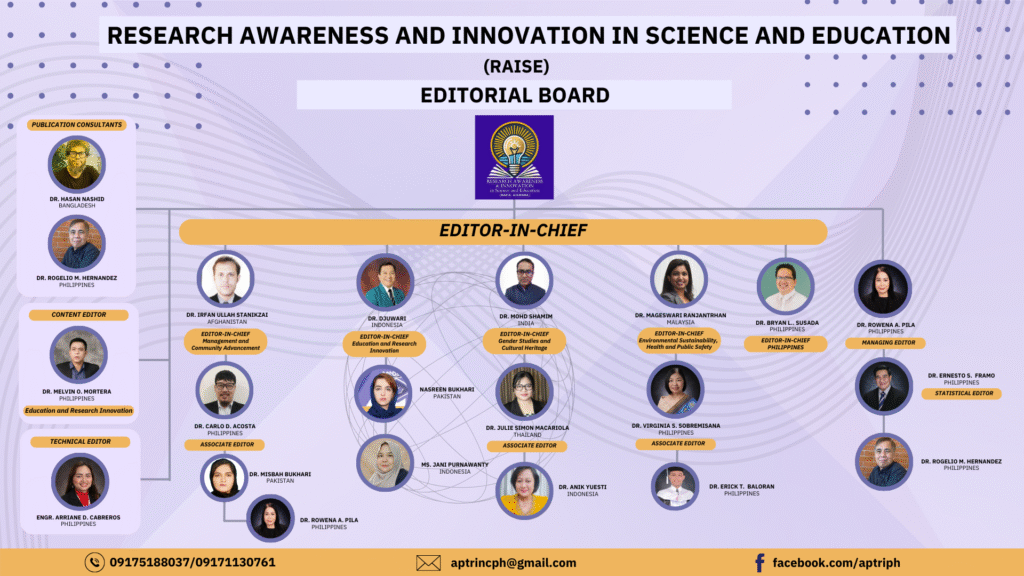
EDITORIAL Organization
published journals
next-gen finance: the role of fintech in shaping a smarter more accessible financial world
Authors: Enkeleda Lulaj, Donjeta Lulaj, Rowena Pila
Date Published: October 2025
https://doi.org/10.1080/07366981.2025.2572226
Abstract
This study examines the role of NextGen Finance, focusing on Fintech models such as NextGenFAFIM, NextGenFAIM, and NextGenFUSIM. It investigates how these models shape a smarter and more accessible financial world. Data were collected from 200 Households in Kosovo between 2024 and Q1 2025 were analyzed using exploratory factor analysis (EFA), multiple regression, and reliability analysis through SPSS and AMOS software. Findings revealed that the three fintech models significantly increased financial inclusion, explaining 78.6 percent of the variance in financial accessibility (R2 = 0.79, p < 0.001) with high predictive accuracy (α > 0.85). Digital asset management and digital wallets were identified as the main drivers, accounting for 65.4 percent of the improvement in accessibility. The research highlights the transformative role of fintech in financial inclusion and suggests that NextGen fintech models offer scalable solutions for emerging markets. Further investigation is recommended to explore their applications in different economic environments.
the implementation of chatgpit in english language learning in the philippines and indones
Authors: Djuwari, Rowena A. PIla, Muhammad Syaik
Date Published: June 2025
https://jurnaledukasia.org/index.php/edukasia/article/view/1431
Abstract
ChatGPT has gained popularity in research writing and language teaching, yet its specific influence on students’ English learning processes remains underexplored. This study aims to investigate students’ experiences using ChatGPT in English language learning from two countries: the Philippines and Indonesia. Employing a qualitative research design, the study purposively collected data from 90 university students—50 from University Technology in the Philippines and 40 from Universitas Nahdlatul Ulama Surabaya (UNUSA), Indonesia. They completed questionnaires via Google Forms, using a five-point Likert scale (strongly agree to strongly disagree) to express their perceptions of ChatGPT’s role in their learning. In addition, interviews were conducted with four teachers (two from each institution) to deepen insights into classroom impacts. Findings reveal that ChatGPT significantly enhances students’ English learning by boosting creativity, encouraging critical thinking, improving engagement, and supporting knowledge retention. It also aids in time management, facilitates collaborative problem-solving, and optimizes learning resources. Teachers reported 13 distinct positive effects on student learning outcomes. Therefore, ChatGPT is a valuable educational tool that transforms traditional learning environments and better prepares students with essential 21st-century skills. It is recommended that ChatGPT be more widely integrated into English language instruction to maximize its benefits.
